
Welcome
Welcome to St Mary and St John Churchyard, a tranquil haven for people and wildlife in the heart of the culturally diverse and vibrant community that is East Oxford.
Established in the 1870’s as a beautiful place of peaceful reflection, it is now:
-
a home for a wide variety of wildlife including many trees, flowers, birds, animals, butterflies and bees
-
the final resting place for people from many social groups in our community, with graves and memorials for key local individuals, children, workhouse residents, members of religious orders, servicemen from the two world wars, all giving an insight into local history
-
a place of tranquillity for people to spend time in nature, whether by walking the paths, sitting quietly, using the meditative labyrinth
-
a place of community for the living.
Do visit and enjoy the churchyard, respect its quiet nature, find out about the wildlife and gardens, and learn more about what happens here.
For more general information, contact the church via admin@cowleystjohn.co.uk
Visiting the Churchyard
You are very welcome to visit. So that everyone can enjoy it, please:
-
Stay on the paths where possible, as the stone edgings of the graves and any fallen branches can be difficult to see under vegetation
-
Dogs should be on leads, and please pick up after them
-
Please put your litter in the bins provided
-
Don’t climb on memorials as some are fragile


An introduction to the history of
the Ss Mary & John churchyard
The churchyard was laid out in the 1870’s when the church was built, to serve the growing area of East Oxford. When it was consecrated by the Bishop on 1st October 1878, he gave an address which was published in the parish magazine; he noted that he was very glad that the ground was laid out with so much care and taste, for the benefit of local people. The plan of trees, flowerbeds and paths were designed to create a place where the bereaved in particular could walk and be comforted, and have happier memories of their loved ones. Many of the original trees planted are still there today.
For nearly 100 years, church members and the families of the deceased cared for the graves and the churchyard as a whole. However after the Second World War, many families had moved away, volunteers were in shorter supply, the church no longer employed a gardener, and so much of the churchyard gradually fell into neglect, becoming completely overgrown with self-seeded trees, brambles and ivy. By the 1990’s it was almost impenetrable. Anti social behaviour became a problem, with camps of drug dealers and drinkers. Something had to be done. In 2000, a group of soldiers from the Pioneer Regiment came in as volunteers to clear the dense growth and made a start on the accumulated rubbish– but the church realised the problems could soon return again. A survey of the local community on what the future of the churchyard should be led to the conclusion that it should be managed for wildlife, and that people should have full access to enjoy it.
The churchyard was then closed for further burials. A restoration project began in partnership with the local community, the Council, and local ecologists. After consultation with the Council tree team, unsafe trees were removed, and a planting project began, starting with the newly created woodland Garden of Remembrance and Thanksgiving. Key graves were restored or made safe, and the Oxford Family History Society undertook a project to record all the memorial stones and their inscriptions. In 2003 the churchyard was designated a Jubilee Wildlife Space, one of 10 in Oxfordshire created as a tribute to the Queen for her golden jubilee.
Grant funding was obtained from various sources for discrete projects, including a grant in 2005 from The Heritage Lottery Fund to develop educaional materials on the wildlife and local social history. It also included funding to restore selected memorials and repair some of the others for safe access.
The front garden was redesigned to make a community garden with flowerbeds, lawn and trees. Here the Trinity Labyrinth was installed in 2003, commissioned by Fusion, Oxford’s community art agency at the time, and designed by Fuller MacKeith Art & Design Partnership working with people from mental health support groups in East Oxford and with members of the church congregation.
In the following years, the grassland areas were brought into management to encourage floral diversity, hedges were planted, and trees were planted where required, under a series of management plans drawn up by local ecologists. The work was mostly done by volunteer teams with some input from the City Council. The work continues to this day.

Management of the churchyard
The churchyard forms part of St Mary & St John Church and is owned by the Oxford Diocese in partnership with the Parochial Church Council (PCC). As the churchyard is now closed for burials, responsibility for its ongoing maintenance rests with Oxford City Council, delivered through Oxford Direct Services (ODS). This includes routine grounds maintenance, such as lawn mowing, as well as responsibility for tree safety and the management of damaged or potentially unsafe gravestones and memorials.
We aim to:
-
manage and enhance an accessible and biodiverse green space with a distinctive character
-
maintain an appropriate setting for the church building and for church activities
-
care for the churchyard as a consecrated burial ground and as a place for ash burials, looking after the memorials and maintaining access to them where possible
-
create, restore and manage habitats for wildlife and biodiversity
-
curate the churchyard’s landscape value and natural beauty
-
provide a safe and welcoming setting for local community activities and events
-
run occasional churchyard and wildlife themed events
-
retain where still appropriate the original vision for the churchyard when first laid out.
To achieve these aims, volunteers litter pick, keep paths clear, weed and plant up the more formal flowerbeds, make compost, look after the memorials, mow the flower-rich grassland areas using meadow management techniques with late summer and autumn mowing regimes, maintain hedges and wooded areas, remove invasive plants where necessary, and plant trees, shrubs, flowering plants and spring bulbs as required.
If you would like to join the volunteer team, get in touch via the church or email ruth-ashcroft@ntlworld.com.
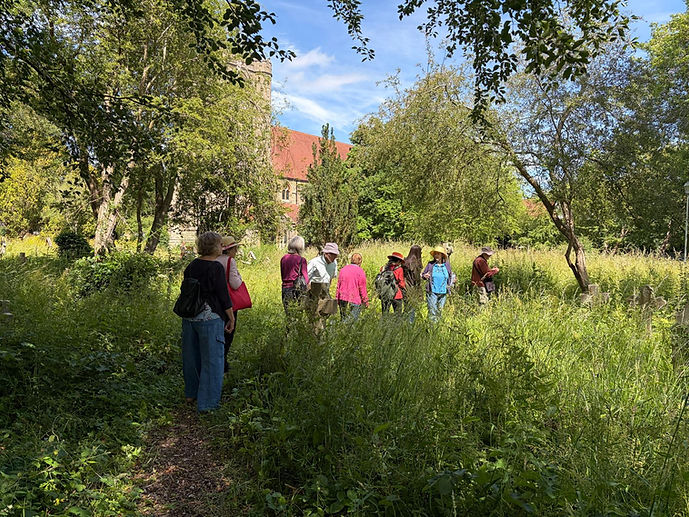
Wildlife and biodiversity
Churchyards everywhere play an important role in protecting and enhancing biodiversity. This is particularly true for
SS Mary and John Churchyard as it is a good-sized plot in the middle of an area of dense housing with little other green space easily accessible for local residents. Managing the churchyard for biodiversity creates a tranquil natural environment for everyone to benefit from and forms a reservoir of biodiversity to support the plants and wildlife of local gardens. It forms a stepping stone to connect wildlife to other nature sites across the city.
What can you see here?
Have a walk around and see what you can find. Maybe a fox or Muntjac deer! It is a haven for many birds, butterflies and bees. From early spring to autumn there are swathes of wildflowers, and always a varied tree-scape.
Trees. Half the site is wooded. Many of the mature trees here date from the original plantings around the time the churchyard was set up in the late 1870’s. These include the two Giant Redwoods (Wellingtonia), the Corsican Pines, the English and Irish Yews, Horse Chestnuts, and the avenues of Common Lime. Since then, more species have been planted or arrived by themselves: Oak, Goat Willow, Hawthorn, Holly, Sycamore, Ash, Silver Birch, Wild Cherry, apple trees, and other native shrubs.
In all their stages of life including as dead wood, they form an excellent basis for the churchyard’s biodiversity, help store carbon and purify air, add to the landscaping, and provide shade for visitors in hot summers.
Larger animals. You may be lucky enough to glimpse the fox that has lived here for many years, and the visiting badger and Muntjac deer. There are numerous Grey Squirrels which entertain visitors with their antics.
Birds. Over 30 species are regularly seen including those breeding here and winter visitors. Look out for the jays which are frequent visitors. A few more are occasionally seen, such as nuthatches We maintain secure breeding places such as hedges and bramble patches, and make sure there is plenty of food by growing a wide variety of berry and seed producing plants and by managing for thriving populations of insects and other invertebrates.
Butterflies. The churchyard is excellent for butterflies with 17 different species seen. The large variety of grasses and flowering plants helps them both for pollen and nectar, and also by providing caterpillar food plants including nettles.
Thess also support numerous moths, bumblebees and many smaller species of bee.
Flowers. A wide variety of flowering plants, mostly native to the UK, underpins the biodiversity of the churchyard. Enjoy the swathes of tree blossom, spring bulbs, primroses and cowslips from late February, which then give way to the meadow flowers (eg daisies, meadow cranesbill, knapweeds and scabious) which continue until early autumn. The southeastern part of the churchyard is damper, often underwater in winter, and here you will find a different array of flowers such as meadowsweet and loosestrifes. Long grasses through the summer add to the scene and support many insects including moth and butterfly caterpillars. In autumn note the sweet-smelling ivy flowers, often covered in bees and Red Admiral butterflies. You will also find through the autumn and winter numerous types of fungi.
Gardened areas.
The more formal flowerbeds, the Garden of Remembrance and Thanksgiving, and the Bee and Butterfly Garden all include both native and garden flowers, mostly chosen to be pollinator friendly. Throughout the whole churchyard we avoid use of herbicides and pesticides.


Events, resources, church links, contact details
Contact details. For most enquiries, the general contact is admin@cowleystjohn.co.uk. Enquiries will then be directed towards the appropriate person to respond.
See also the main parish website http://cowleystjohn.co.uk.
Events. The churchyard team run occasional events such as planting days, and an annual event to participate in the “Churches count on nature” week co-ordinated by the charity Caring for God’s Acre, where we record the wildlife and plants found.
There are also walks looking at the geology of gravestones, seasonal meditation sessions, and other events.
To be added to the mailing list for churchyard events email admin@cowleystjohn.co.uk
Resources
Good resources for managing churchyards for wildlife:
Caring for God’s Acre. https://www.caringforgodsacre.org.uk – lots of advice on managing churchyards
Wilder Churches – a partnership between the local Wildlife Trust BBOWT and the Diocese of Oxford to boost biodiversity in churchyards. https://www.bbowt.org.uk/team-wilder/churches and https://www.oxford.anglican.org/environment-and-social-justice/environmental-action/biodiversity
A Rocha / Eco church. Library of resources. https://ecochurch.arocha.org.uk/resources/land/
Wild Oxfordshire – https://www.wildoxfordshire.org.uk/guidance/helping-nature-on-your-patch. Good source of advice on managing land for wildlife in general and for specific types of wildlife.
Upcoming Events
No events at the moment
Acknowledgements
This website has gathered material from many people associated with east Oxford and the Parish of Cowley St John, but particular thanks go to the major contributors:
Annie Skinner, who carried out the research, drew up the Tables of memorials and wrote the historical fact sheets.
Julie Norris, who designed and wrote the leaflets on the seasonal wildlife and on interesting and artistic monuments
Jayne Saberton-Haynes, who wrote the Teachers’ Guides for Key Stage 1 and 2
Wendy Cartwright, who wrote the Teachers’ Guides for Key stage 3 and 4 and 5
John Ashdown, author of the fact sheet on the Grimsley Family of Memorial Sculptors
Malcolm Graham, Head of Oxfordshire Studies, whose own research and advice have underpinned a great deal of current study of the area
Julian Litten, President of the Church Monument Society, who carried out an assessment of the churchyard monuments.
Bob Jeffery, former sub-Dean of Christ Church, who advised on the life and mission of Father Richard Benson
John Boyl, who contributed text and photos from his account of the history of the Methodist Church
Margaret Cullen, artist and source of oral history
The Society of the All Saints Sisters of the Poor, for photos from their archives.
Steve Allen, who has built the website
Ruth Conway, co-ordinator of the churchyard restoration project, who wrote the various accounts of recent developments.
Crucially, the preparation of this educational resource, and the restoration work in the churchyard that allows for safe educational visits, has been made possible by a major grant from the Heritage Lottery Fund.
Copyright
The purpose of the website is to encourage more people, particularly the younger generation, to enjoy the natural peace and beauty of the churchyard and learn about the social history of the area and its past inhabitants. Teachers and educators are therefore especially welcome to use the content, provided the website and the authors are acknowledged as the source.
Copyright is held by Ss Mary & John Church. If you have any queries relating to copyright issues or the reproduction of material, please contact info@ssmjchurchyard.org.uk
Copyright in some material included on this site is held by third parties who have given permission for its use. In the case of pictures this is normally indicated in a caption accompanying the image. If any material inadvertently infringes copyright, please contact as above.
